

They helped quietly
No announcement, no expectation of credit. They just showed up and did the thing, and you have never really named it back to them.
Name the small specific act, not the general kindness.
When a card is not enough and a long text feels wrong
Some people are hard to thank because the thing they did was too big, too quiet, or too long ago. A teacher who saw something in you. A friend who sat with you during the worst week. A parent who never made a thing of it. A coworker who covered for you when nobody was watching. The words exist somewhere, but they tend to stay there.
Songilingy turns what you would say if you could say it out loud into a song made for one person. You move through a short set of questions about who they are and what they did, and we shape it into something they can keep. You get a free full song preview before payment. When a version feels right, you unlock it for $29.99.
A thank-you is easier to hear when it names what someone actually did. This one names a lesson, a habit and a lunch hour.
From a former student, now a teacher, to her eighth-grade science teacher
Twenty years on, a fifth-grade teacher thanks Mr. Okafor, who taught her eighth-grade science. His line "Ask the next question" is painted over her own classroom door, and in the year her parents split, he let her eat lunch in his room without asking why.
The detail it is built on: His own mistakes went up first on his "mistake of the week" board.
An original Songilingy example. The people and story in it are fictional. A sound you choose guides the music; your song uses your own story and lyrics.
Thank-you gifts are strange because the moment to give one rarely arrives on a calendar. There is no anniversary of the day someone believed in you. There is no holiday for the neighbor who watched your dog for a year, or the nurse who stayed past her shift, or the friend who drove four hours without asking why.
That is the part this page is about. Not the polite thank-you that fits on a card, but the one that has been sitting in the back of your mind. The kind you want to say properly, once, in a way that lasts longer than a text message.
No announcement, no expectation of credit. They just showed up and did the thing, and you have never really named it back to them.
Name the small specific act, not the general kindness.
A mentor, a teacher, a first boss, the person who told you to apply for the thing. You would be living a different life without them.
Mention the moment of the nudge, and where you ended up.
Illness, loss, the year that fell apart. They did not try to fix it. They sat with you in it.
A small image works better than a big statement here.
Parents, grandparents, long-time partners, the friend who has been there since you were sixteen. The kind of love that does not perform itself.
Pick the unglamorous detail: lunches packed, rides given, calls returned.
A hiring manager, a coach, a host who opened their home, a stranger who became a reference. They had no reason to, and they did.
Say what you would not have without them.
A thank-you song for a coach should not sound like a thank-you song for a grandmother. The shape of the gratitude changes with the relationship. Here is how the song tends to lean depending on who it is for.
Steady, warm, a little reflective. The student who finally turned around to say it.
What they taught beyond the subject, a phrase they used, the year you had them.
Tender, unhurried, lived-in. Less drama, more specific small memories.
An ordinary ritual, a meal, a phrase, a place that always meant them.
Honest and close. Sounds like one person talking to one person, not a speech.
The hard season, what they did without being asked, what you owe them.
Grounded and respectful. Acknowledges the work without flattening it.
What they did when no one was watching, the moment you noticed.
Light, gracious, specific. The kind of thank-you that does not get awkward.
Where they hosted, what they made room for, how long they did it.
You are not staring at a blank box trying to find the right words. You answer a few questions about the person and the thank-you you owe them, and the song is shaped around your answers.
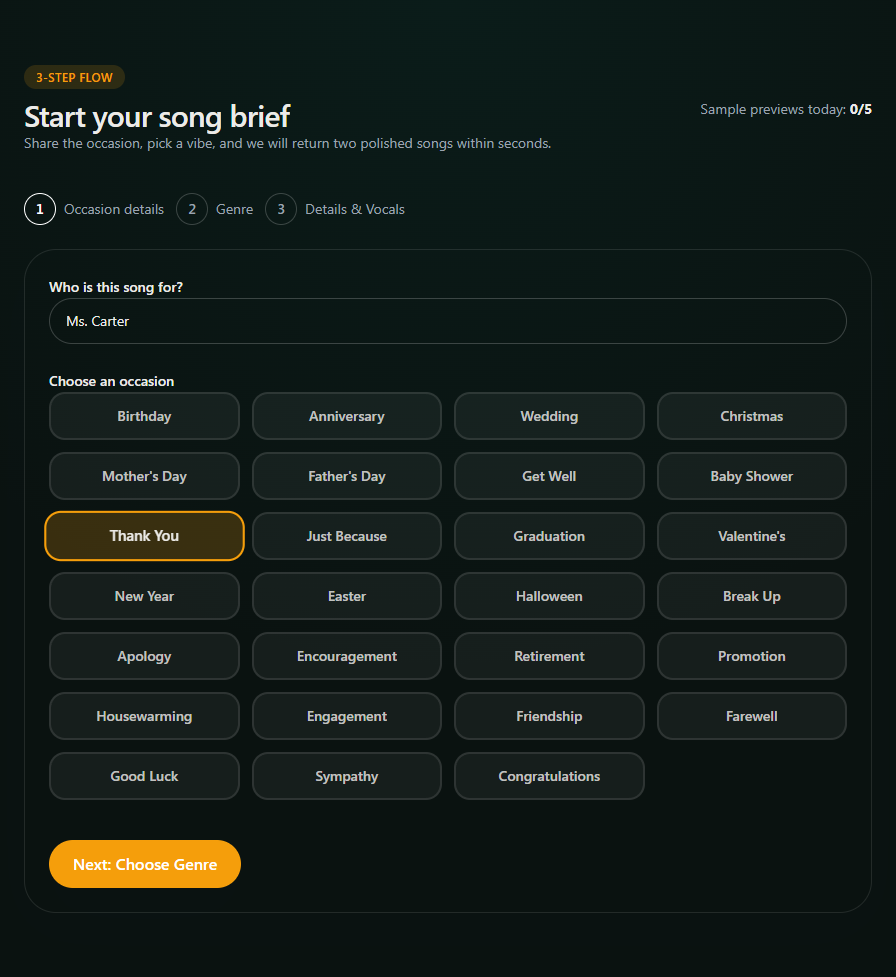
Step 1
Start with their name and the relationship. Then name the thank-you. Not the polished version. The real one. What did they do, and why has it stayed with you.
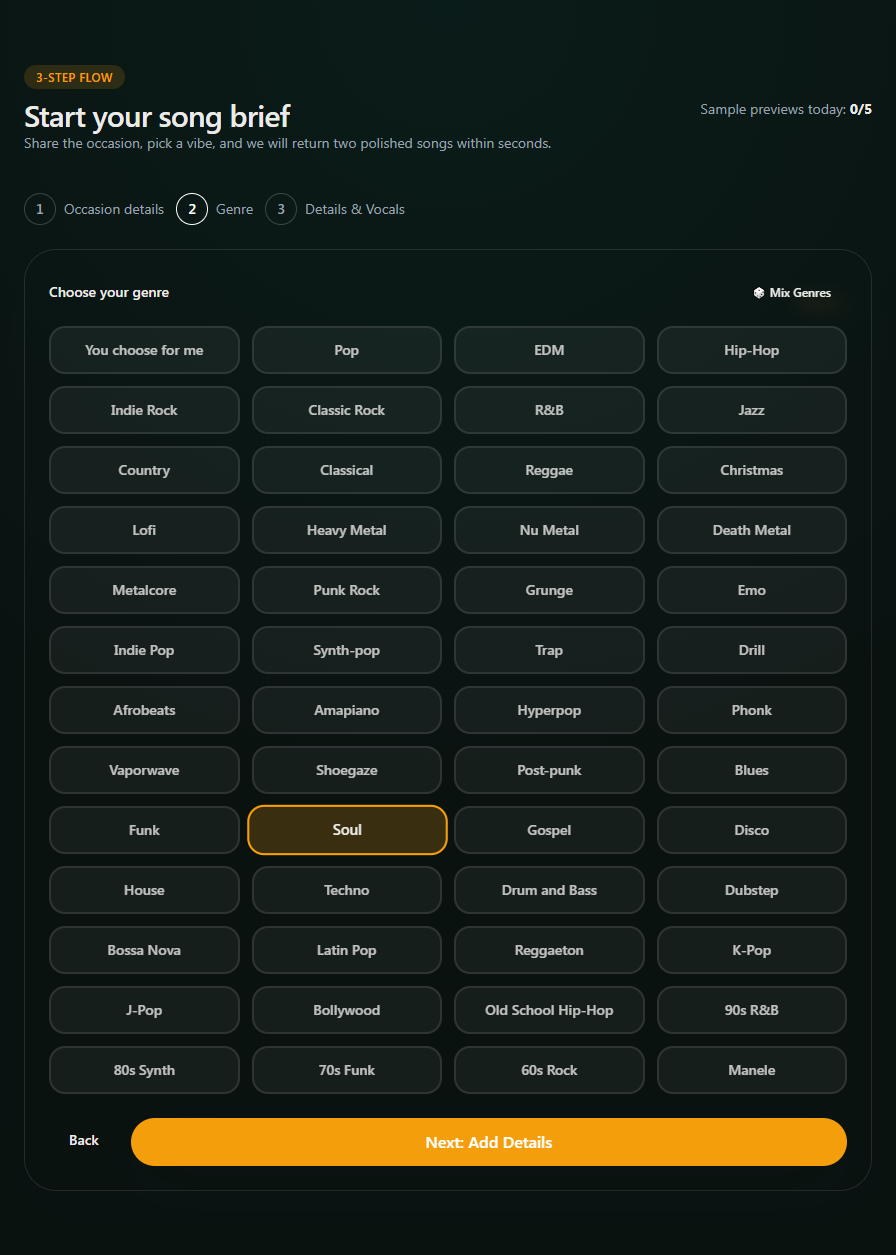
Step 2
Pick a genre or blend two if their taste sits between styles. Choose the language and the kind of voice that fits the person, not what you would pick for yourself.
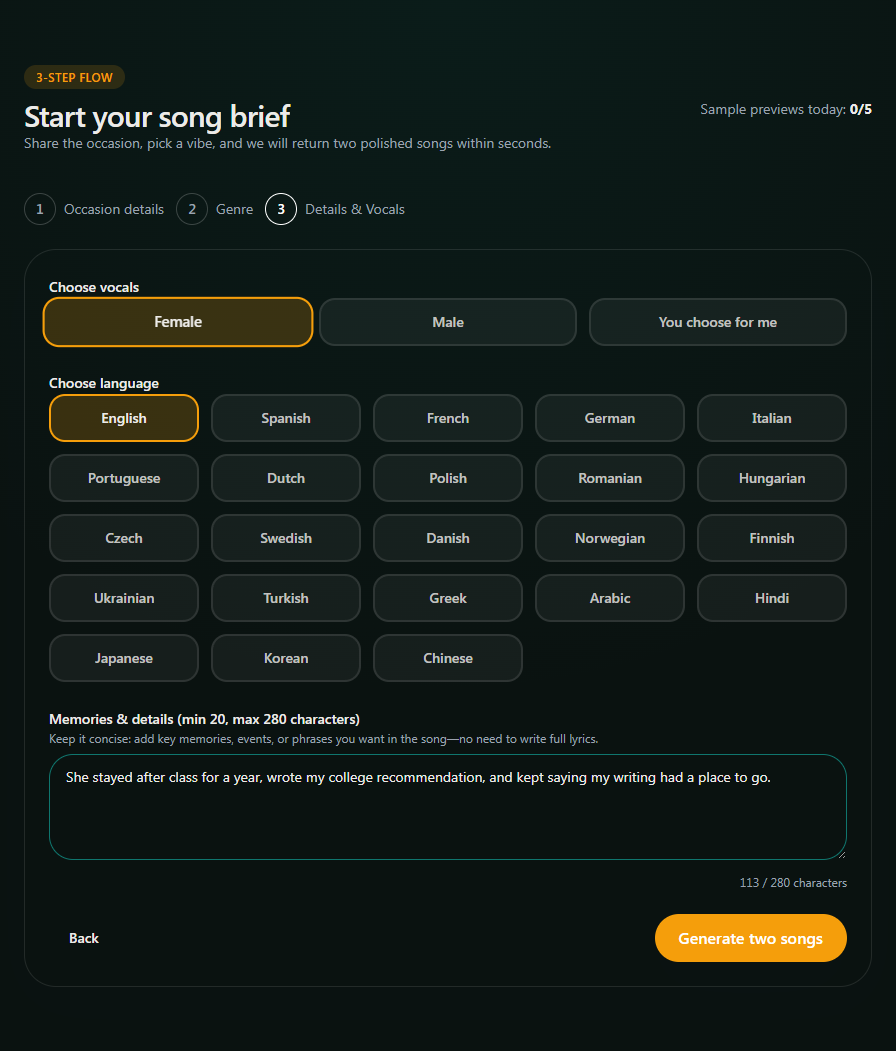
Step 3
This is the part that makes the song feel like them. A phrase they say, a year, a place, a habit, something only the two of you would understand. The more specific, the less it sounds like anyone else.
Most thank-you messages stay general because being specific feels risky. Songs are the opposite. The more specific the detail, the more the person on the receiving end feels seen. A few examples of weaker lines and what to say instead.
Thank you for always being there.
Thank you for picking up at 2 a.m. in November and not making me explain.
Specific time, specific behavior. Nobody else gets that line.
You taught me so much.
You taught me to read a sentence out loud before I trusted it.
Names the actual lesson, not the abstract idea of teaching.
You were a great mentor.
You gave me the project nobody else would let me near.
Shows the risk they took, which is the real thank-you.
Thanks for hosting us.
Thanks for the green kitchen, the late breakfasts, and never asking when we were leaving.
Sensory details turn a polite line into a memory.
You always believed in me.
You told me to apply anyway, and I did, and here I am.
Names the action and the outcome instead of the feeling.
I do not know what I would do without you.
I would still be in that apartment, in that job, with that version of me.
Concrete contrast does more work than a hypothetical.
A thank-you song does not have to be solemn. The right tone is whatever the person would actually want to hear. Five directions that tend to work.
Tone 1
Slow, sparse, mostly voice. For people who do not like a fuss made about them.
Acoustic, soft folk, gentle piano
Tone 2
Looks back without getting heavy. For long relationships and shared history.
Soft pop, country lean, mellow soul
Tone 3
Affectionate without being sentimental. For friends, hosts, and people who would roll their eyes at a serious song.
Indie pop, easy acoustic, light jazz
Tone 4
Acknowledges what someone did without overdoing it. Good for coworkers, caregivers, and professional thank-yous.
Mid-tempo pop, gospel-tinged soul, soft R and B
Tone 5
When the thank-you deserves volume. For people who would love being made a deal of.
Upbeat pop, soulful big-band, anthemic
A song works in a lot of moments a card does not. A few of the ways people share the final version.
A link in a message with a short note. Often the right move for a thank-you that has been a long time coming.
At dinner, in a car, on a porch. The song does most of the talking, which is sometimes the whole point.
A handwritten card with a link, or a printed lyric sheet next to flowers, a bottle, or a framed photo.
A retirement, a last shift, a goodbye, a milestone the person did not plan to mark. Songs hold up well when the moment arrives.
There is no fixed list, but these are the relationships that come up most often.
End of the year, end of a program, or years later when you finally understand what they did.
Not for a birthday, just because. The thank-you that ordinary life does not make room for.
The one who showed up during the divorce, the diagnosis, the move, the year that did not go to plan.
The person who saw what you could do before you did, and made you keep going.
For the people who took care of someone you love, in the way you would have if you could.
The thank-yous that get said in passing and never properly. A song closes that loop.
A few short scenarios to show how the same idea takes different shapes depending on the person.
Start your thank-you songA slow acoustic song addressed to Mr. Alvarez, naming the essay he made you rewrite four times and the sentence of his you still think about. Sent as a link with a short note.
An indie-pop song with a quiet chorus, full of small details only she would catch: the apartment, the cheap wine, the night you finally laughed again.
A mid-tempo, soulful song that names her by first name, the ward, the small thing she did that the family never forgot. Given with a card on the last day.
A warm, country-leaning song about ordinary years. School lunches, long drives, the porch light always on. Played at a regular Sunday dinner.
Most thank-you songs work. The ones that do not tend to fail for the same reasons.
If the song could be sent to three other people without changing a word, it will not land. Specifics are what make it theirs.
The song is for them. If they have listened to country radio for forty years, that is the right answer, even if it is not yours.
One clear thank-you, well told, beats a list. Pick the moment or the trait that matters most and let the song stay there.
The slightly awkward, slightly too-honest version of what you want to say is usually the one worth keeping. The song can hold it.
Short answers to the things that come up most before someone starts.
No. The flow asks you what you want them to hear. You can write a few rough sentences and let the song shape them. You are not writing lyrics from scratch.
Yes. You get a free full song preview before payment. You can listen, adjust the details, and only unlock a song when it feels right.
$29.99 for the version you choose. That gives you the full song to keep, share, and send.
Yes. The guided flow gives you a free full song preview to listen to before you choose, so you are not guessing which direction works better.
Yes. You choose the language during the flow, which matters for thank-yous to parents, grandparents, and family members who would feel it more in their own language.
More specific than feels natural. Names, places, small habits, single sentences they have said. That is the difference between a song that sounds like anyone and one that sounds like them.
That is often when these songs work best. The distance is part of the point. You are finally saying the thing you have been carrying.
Custom Thank You Song songs
Start a free full song preview. Move through the questions, listen to the song, and see if the song sounds like the person you have been meaning to thank. If it does, you can unlock it for $29.99 and send it whenever the moment is right.
Use these pages when you know who deserves the song, but want more help with the relationship, occasion, or sound.
Thank your pastor for the visits, encouragement and small acts of care your church remembers.
Shape a thank-you around the class, the lesson, and the sentence that stayed with you.
Use this when the thank-you is really for years of quiet, ordinary care.
Good for the friend who carried the hard season and never asked to be repaid.
Keep the tone warm, specific, and appropriate for a team thank-you or farewell.
A useful angle for mentors, managers, and the person who took a chance on you.
Use this if the thank-you belongs inside a send-off or last-day celebration.
Listen to different styles before choosing a quiet, warm, playful, or celebratory sound.
Open the guided flow and turn a specific thank-you into free full song preview.