
They are open to hearing from you
If they have not blocked contact and have not asked for distance, a short message first is respectful. A song can follow if they say they are willing to receive it.
Consent before delivery
For when a text is not enough, and you still owe someone honesty
An apology song is not a clever workaround. It is one way to slow down, gather your thoughts, and say something you mean in a form the other person can sit with on their own time. Songilingy helps you shape that message through a guided flow, so the result sounds like you and not like a greeting card.
Before you start, it helps to be honest with yourself about what this song is for. It is not a tool to win someone back, smooth over a pattern, or pressure a response. It is a considered way to name what happened, take responsibility, and let the person you hurt decide what comes next.
A song will not repair a relationship on its own. It can carry tone, memory, and warmth in a way that a paragraph of text sometimes cannot, but it cannot replace a real conversation, a change in behavior, or time. If the person you hurt has asked for space, a surprise song is not space. If the harm was serious, the first move is usually a direct, plain apology, not music.
This page is here to help you think clearly. We would rather you pause, talk to the person, and come back later than send something that feels like performance. If, after reading this, a song still feels like the right addition to an apology you are already making in person, then the rest of this page will help you make one that is honest.
If they have not blocked contact and have not asked for distance, a short message first is respectful. A song can follow if they say they are willing to receive it.
Consent before delivery
A song works best as a follow-up, not the first contact. The direct apology comes first, in your own voice, without music doing the work for you.
Plain words first
If you cannot describe the harm clearly, the song will sound vague. Specificity is what makes an apology land. Vagueness is what makes it feel hollow.
Name the harm
Send the song as something you wanted them to have, not as a request. They may listen, they may not, they may need more time. All of that is allowed.
No strings attached
A song can carry these pieces, but only if you are clear on them first. Write them down before you start the flow. The clearer your thinking, the more honest the song will sound.
Step 1
Not a category, the specific thing. Not I was not the best partner, but I dismissed you in front of your sister and walked off when you tried to talk about it.
Step 2
Say what it cost them, in their terms, not yours. Hurt, embarrassment, lost trust, a night ruined, months of doubt. Let it sit. Do not rush to soften it.
Step 3
Not I will try, but the actual habit, conversation, or boundary you are putting in place. If you do not know yet, say that honestly instead of promising vaguely.
Step 4
Close without pressure. No timeline, no plea, no test. Something like, you do not owe me a reply, I just wanted you to have this, is enough.
You move through a short series of questions. Each one is there to make the song feel like it came from you, not from a template. You can hear a free full song preview before unlocking the one you want to keep for $29.99.
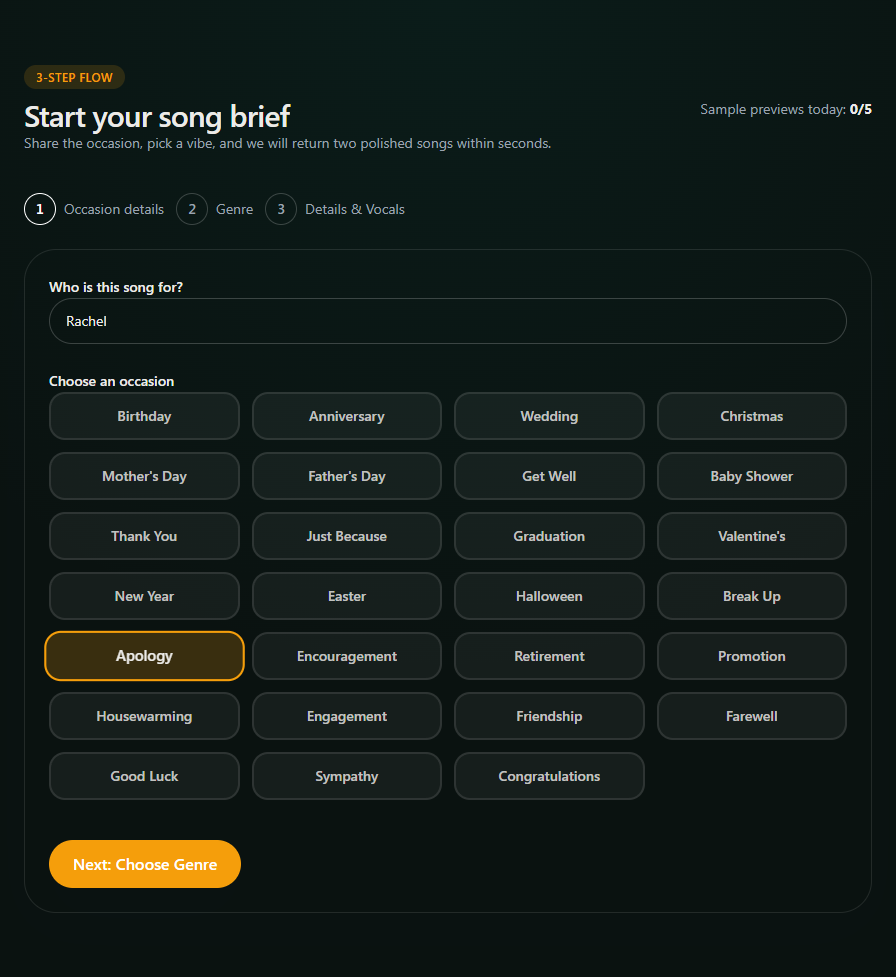
Step 1
Add their name and your relationship. Choose apology as the occasion. This sets the emotional register so the song speaks to one person, not a general audience.
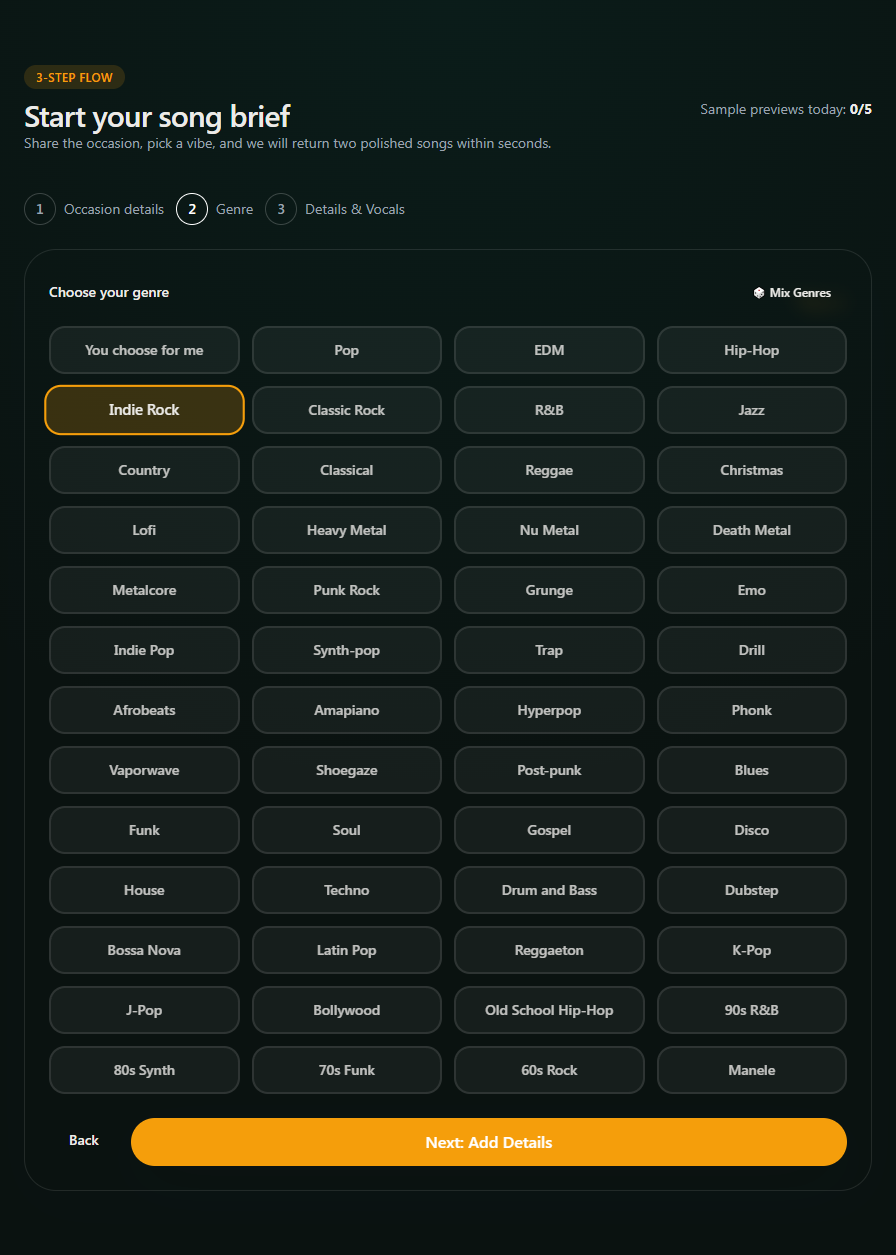
Step 2
Pick a genre, or blend two, that matches how the two of you usually communicate. Choose a vocal style and the language you want the song in. Calmer styles tend to suit apologies better than dramatic ones.
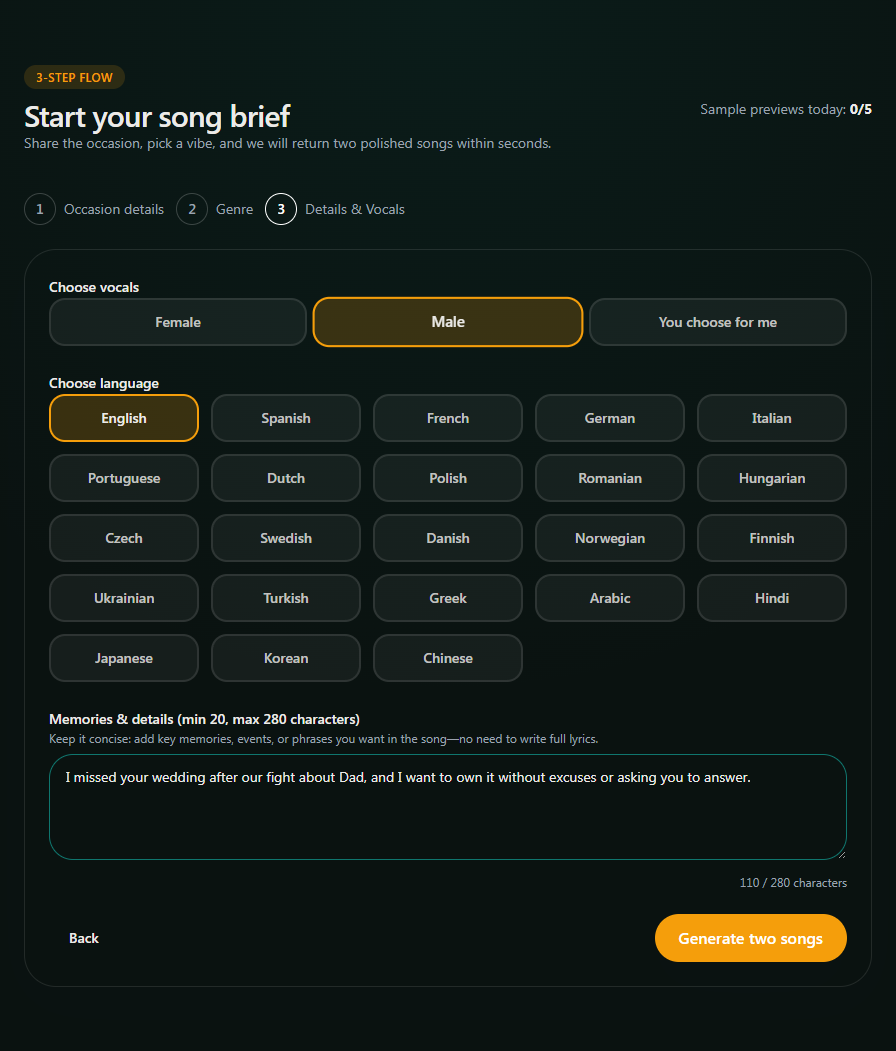
Step 3
Share the specifics in your own words. What happened, what you understand now, what you are changing. The more honest and concrete you are here, the less the song relies on generic phrases.
Apology language is easy to get slightly wrong. These swaps keep the song honest and stop it from quietly putting the burden back on the person you hurt.
I am sorry if I hurt you
I am sorry that I hurt you when I
If makes the harm conditional. That names it as real.
I am sorry you felt that way
I am sorry I made you feel that way
The first blames their reaction. The second takes ownership of what you did.
I never meant to
I know intent did not change the impact
Intent is not the point in an apology. Impact is.
Please forgive me
You do not owe me forgiveness
Asking for forgiveness in the song turns it into a request. Releasing them keeps it a gift.
Things will be different, I promise
Here is the specific thing I am changing
Promises feel cheap. Named changes feel real.
I cannot live without you
I value what we had and I respect where you stand
Dependence is pressure. Respect is not.
The genre and mood carry as much meaning as the words. Match the tone to the weight of what happened, not to what sounds impressive.
Tone 1
A single guitar or piano, soft vocals, slow pacing. Good for serious apologies where the focus should stay on the words.
Folk, singer-songwriter
Tone 2
A gentle full arrangement that feels like a long exhale. Useful when you have already talked and want to leave them with something kind.
Soft soul, mellow R and B
Tone 3
Plainspoken delivery, minimal production, room for the lyrics to breathe. Suits siblings, close friends, and family.
Acoustic indie
Tone 4
A patient, thoughtful feel that does not rush toward resolution. Good when the situation is still raw and needs space.
Ambient folk, lo-fi
Tone 5
Mid-tempo, no big swells, no theatrics. A good default when you are not sure how heavy the tone should be.
Mellow pop
The same words do not fit every relationship. A short note on how to think about each one.
Stay specific and avoid romantic language that papers over the harm. The song should sound like accountability with warmth, not a plea.
Acknowledge what the friendship has meant and what you took for granted. Friends often want honesty more than poetry.
Long histories make apologies harder and more important. Name the specific thing, not a lifetime of patterns, unless you are ready to address those plainly.
Keep it grounded. Skip dramatic phrasing. A calm, clear apology often lands better across generations than something stylized.
Lean professional. A short, respectful song that names the lapse and the change is usually more appropriate than anything heavy or personal.
The delivery matters almost as much as the song. A thoughtful song sent the wrong way can still feel like pressure.
A short message asking if they are open to receiving something from you respects their pace. If they say no or do not reply, do not send it.
Direct message or email, not a post, not a story, not a shared group. An apology in public is a performance, not an apology.
A line or two is enough. I made something for you, no reply needed, I just wanted you to have it. Let the song carry the rest.
No checking if they listened, no asking what they thought. They will say something when and if they are ready.
A few honest scenarios to help you decide before you start.
Start carefullyYou forgot something important to them, you have already apologized in person, and you want to leave them with a kinder closing note than a text.
Something old that you never properly owned. You have reached out, they are open to hearing from you, and you want to put the acknowledgment somewhere they can return to.
If they have asked you not to contact them, a song is contact. Wait. The apology that respects their request is silence, for now.
If the behavior has not actually changed, a song is a substitute for the change, not an addition to it. Do the work first.
These are the patterns that quietly turn an apology song into something that feels off, even when the intent is good.
If most of the song is about how bad you feel, it is not really for them. Keep the focus on what you did and what they experienced.
An apology that asks for a response inside the song puts them on the spot. Release the ask. Let the song be a gift, not a question.
Sweeping language can feel like avoidance. Plain words about a specific incident almost always land better than poetic abstractions.
If they have said they need distance, a song does not count as an exception. It reads as a workaround, not as care.
A public apology shifts the audience away from the person you hurt. It can feel like pressure to respond a certain way. Keep it private.
Honest answers to the things worth thinking about before you start.
No, and it should not be made with that goal. Forgiveness is theirs to give on their own terms. A song can show care and effort. It cannot, and should not, manufacture a response.
No. The direct apology, in your own voice, comes first. A song works as a follow-up that gives them something to sit with privately. If you have not had the real conversation, have it first.
That is a possible outcome and you should be ready for it before you send. Their silence is information, not rejection of the gesture. Respect it.
Yes. You can create a free full song preview before payment. When one feels right, you can unlock it for $29.99.
Short is usually better for apologies. Long songs can start to feel performative. A focused two to three minutes that names one thing well is more meaningful than something sprawling.
A few, carefully chosen, can help the song feel like it is for them and not for anyone. Avoid using shared memories as leverage. A memory is context, not a guilt trip.
Then do not send it yet. Save it, sit with it for a day, talk to someone you trust, or have the in-person conversation first. The song will still be there when you are sure.
Custom Apology Song songs
An apology song works when it is part of a larger, honest effort. Name what you did, say what you are changing, leave the next step to them, and send it privately if and when they are open to it. If that is where you are, the flow is here when you want to start.
Use these pages when the apology depends on the relationship, the tone, or whether the message is closer to appreciation.
A shorter path with three playable examples, editable lyrics, and a free full song preview.
Use this when the apology is part of a relationship that still needs warmth and care.
Shape the song around accountability, shared history, and a tone that does not pressure.
Helpful when the apology belongs inside a long relationship with real history behind it.
Find relationship-specific angles for a private apology or repair conversation.
Use this when the person you hurt is a friend who deserves a clear, personal apology.
A softer companion page if the message is more appreciation than apology.
Listen to quieter, warmer, and more restrained styles before choosing the sound.
Open the guided flow and create a free full song preview when you are ready.
Guides and ideas