
A long recovery
Healing that is taking longer than anyone expected, and the early flood of check-ins has quieted down.
A calm song that names the patience this is asking of them, without rushing the ending.
Custom encouragement song
Some people in your life are carrying something heavy right now, and the usual texts feel too small. You want to send something that lands. Not a pep talk. Not a quote graphic. Something that says you have been paying attention.
Songilingy turns the details you already know about them into a custom song with vocals. You guide it. We shape it. They get a piece of music that sounds like someone is actually in their corner.
The hardest part of supporting someone is not the words. It is the tone. Too cheerful and it stings. Too serious and it feels heavy. Most encouragement messages miss because they try to fix instead of sit beside.
A supportive song does something a card cannot. It stays. They can play it on the walk to work, in the car before a hard meeting, in the kitchen at midnight when the day refused to end. It becomes a small, steady voice they can return to.
These are the seasons that send people looking for an encouragement gift. None of them need a grand speech. They need presence.
Healing that is taking longer than anyone expected, and the early flood of check-ins has quieted down.
A calm song that names the patience this is asking of them, without rushing the ending.
A layoff, a leap, a hard pivot, a job search that has stretched into months.
Something that respects the work they have already done and the doubt that creeps in at 2am.
A student deep in exams, a thesis, a clinical rotation, or a first year that is breaking them open.
A song that treats their effort as serious, not cute.
A new parent, a caregiver for an aging parent, someone who suddenly holds more than they can hold.
A piece that honors the love and the exhaustion in the same breath.
Not a memorial song, but a quiet encouragement for someone learning to live around a loss.
Gentle, unhurried, with room to breathe.
Someone you cannot drop in on. Different city, different country, different time zone.
A song that closes the distance for the three minutes it plays.
Encouragement falls flat when it skips the hard part. These are the layers we build in, drawn from what you share in the guided flow.
Before anything lifts, the song names what they are actually in. The season, the weight, the specific shape of it.
A line or image from your shared history. Something only the two of you would catch. This is what stops it from sounding generic.
Not hype. A grounded sentence that says, I have seen you do hard things before, and I am not guessing about you.
Room for them to be tired, slow, unsure. Encouragement that does not demand a performance back.
A closing that returns to you, still here, still nearby. Not advice. Just company.
You do not write lyrics. You answer a guided set of questions, and the song is shaped from your answers.
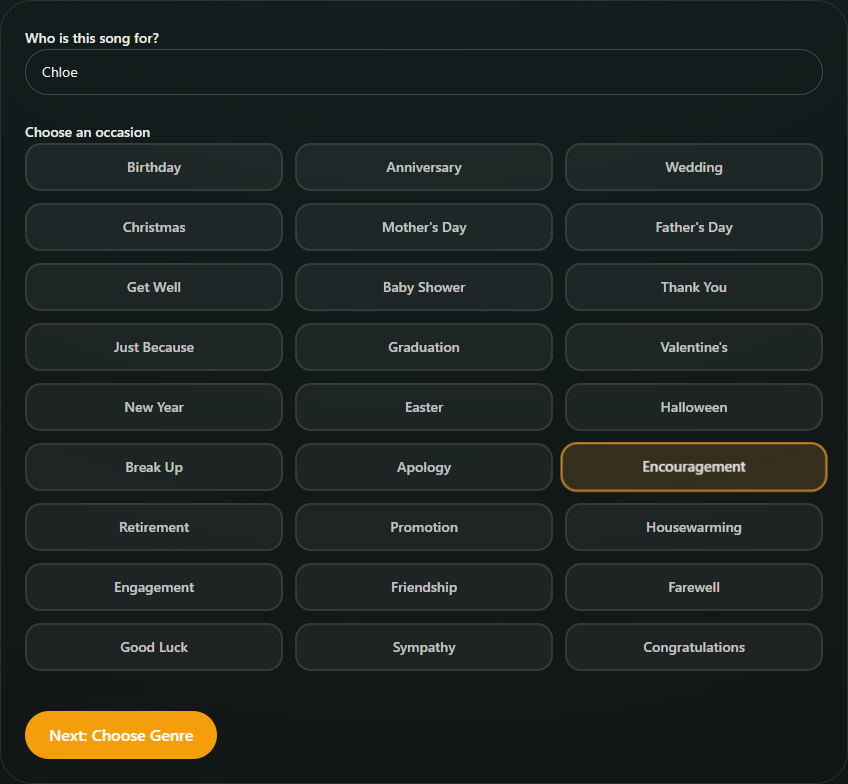
Step 1
Their name, your relationship, the occasion you are marking, and the language you want the vocals in. This is where the song stops being about anyone and starts being about them.
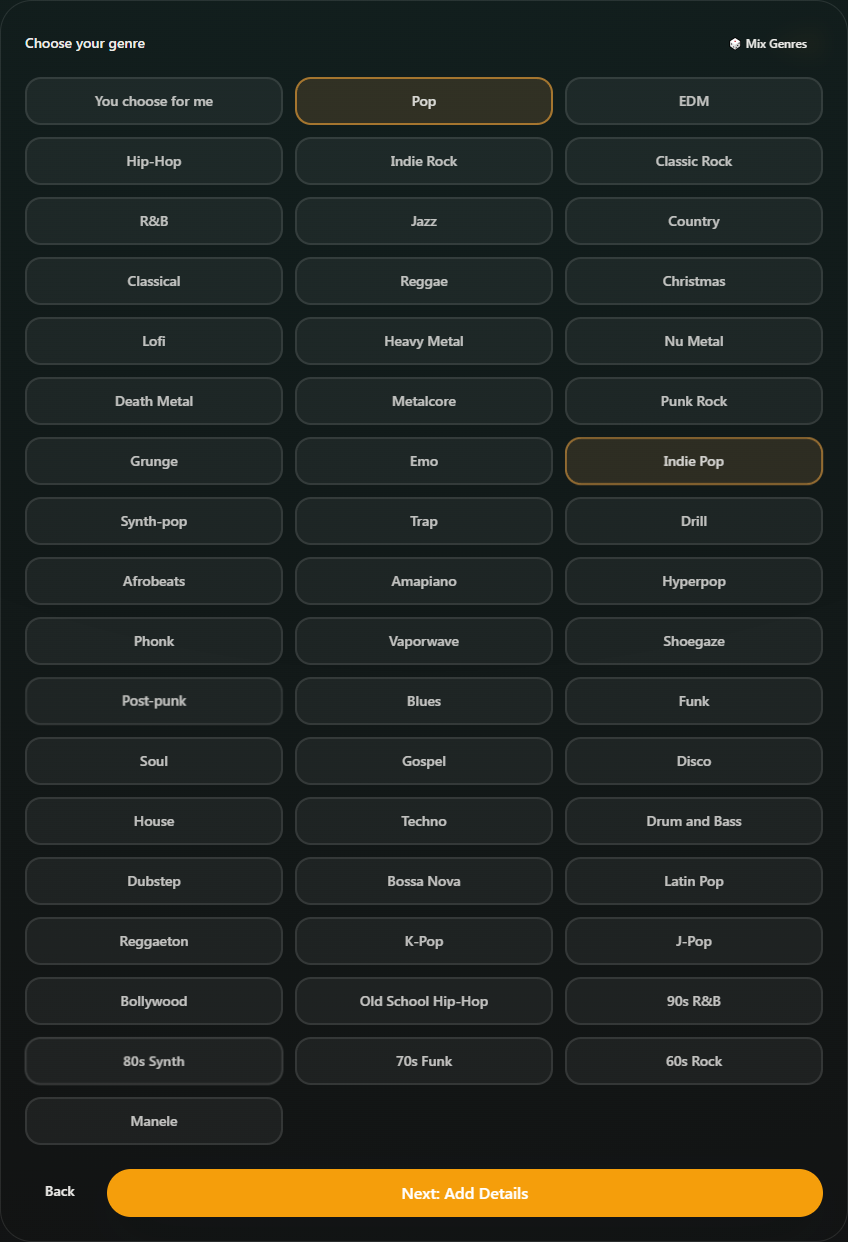
Step 2
Pick a genre or blend two, choose a vocal feel, and set the energy. Soft acoustic, slow piano ballad, warm indie folk, gentle R and B, lo-fi, whatever fits the person.
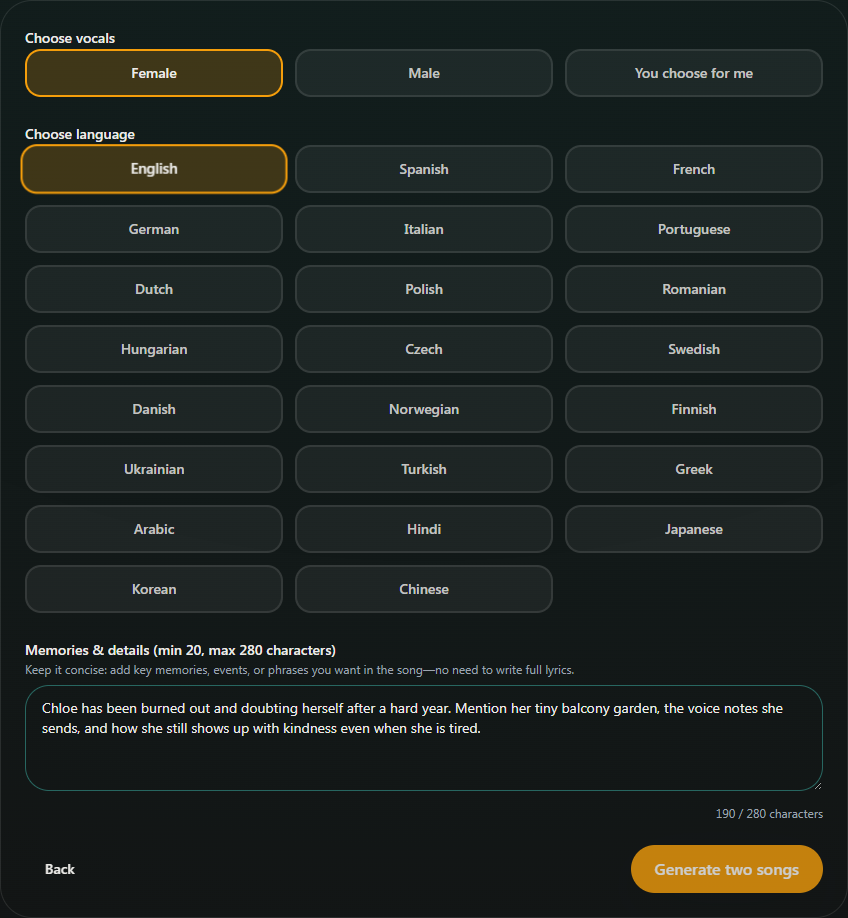
Step 3
Memories, inside references, what they are going through, what you want them to hear, what you would say if you were better with words. Then listen to a free full song preview before payment, and unlock the final for $29.99 when one feels right.
The guided flow asks for specifics. These are the kinds of things that turn a generic supportive song into something that sounds like them.
Job search, recovery, a move, a long stretch of caregiving, a class that is wrecking them. Name it plainly.
Two weeks feels different than ten months. The song can hold either, but it needs to know.
Their go-to expression, a joke between you, the way they sign off texts.
A past hard thing they came through. Belief sounds different when it is rooted in evidence.
If they are sick of being told to stay positive, tell us. We will steer around it.
A place, a season, a small ritual. Morning coffee, a porch light, the drive home. Concrete pictures carry more than adjectives.
Style matters here more than almost any other occasion. Pick the one that matches how this person actually listens.
Fingerpicked guitar, room for the words to land. Good for friends who want something honest, not anthemic.
Acoustic folk
Slow chords, soft vocal. For grief-adjacent moments and quiet recoveries.
Piano ballad
A little more movement, brushed drums, a chorus that opens up without shouting.
Indie folk
Smooth vocal, soft keys, late-night feel. For someone who needs to feel held more than rallied.
R and B
Starts small, builds slowly, lands somewhere brighter. Use when they are ready to be lifted, not before.
Cinematic pop
Encouragement loses power when it stays general. Here is what gets traded in when you share specifics in the guided flow.
Flat
You are so strong
Grounded
You drove yourself to that appointment alone in February
Why
Names a real moment, so the strength is not abstract.
Flat
Everything happens for a reason
Grounded
I do not know why this year has asked so much of you
Why
Honest beats tidy. They can feel the difference.
Flat
Stay positive
Grounded
You are allowed to be tired of this
Why
Permission lowers the pressure to perform okay.
Flat
You got this
Grounded
You have come back from harder rooms than this one
Why
Belief grounded in their actual history.
Flat
Sending good vibes
Grounded
I am two blocks and one phone call away
Why
Presence is more useful than vibes.
Flat
Better days ahead
Grounded
There is a porch light on for you whenever you get here
Why
An image they can actually picture.
You can create a song for someone in almost any role in your life. The tone shifts with the relationship.
Inside references, the long history, the way you two talk when no one else is around.
Tender and specific. The small things you notice that they think no one sees.
Shared childhood, shared shorthand, the kind of belief that does not need to be polite.
A parent's voice without lecturing. Steady, proud, patient with the season they are in.
For when the roles have started to shift and you want them to know you see how much they carry.
Warm but appropriate. Encouragement for a specific stretch of work or study, without crossing lines.
Rough pictures of how different encouragement songs come together. Yours will not sound like any of these. That is the point.
Indie folk, English, male vocal. Mentions the coffee shop where she revises her resume, the dog that waits by the door, and the quiet line: you have not run out of what makes you good at this.
Acoustic, slow tempo, soft male vocal. Names the highway between your two cities. Closes with: take it one ordinary Tuesday at a time, I am not going anywhere.
Warm piano with light strings, female vocal. References her childhood nickname, the lamp in her dorm room, and the steady reminder that tired is not the same as failing.
Piano ballad, low energy, gentle vocal. No fixing. Just: I am thinking about you on the days no one is texting anymore, and I am still here.
Short answers to what comes up most often when someone is making a personalized encouragement song.
That is the normal starting point. The guided flow asks you small, concrete questions. You share what you know about them, and the song handles the shaping.
Yes. You get a free full song preview before payment, so you can hear the direction before you unlock. You only unlock the full song for $29.99 once a version feels right.
Tell us in the details step. We will keep the tone honest and quiet rather than upbeat. A supportive song should not push someone to feel better than they are.
Yes, and you can blend two if you want. Acoustic folk leaning into indie, piano ballad with light strings, R and B with a lo-fi feel. Pick what they actually listen to.
Choose the language during the flow. Pick whatever they will feel most spoken to in, including the language you two use with each other.
As personal as you want. Names, inside jokes, the street they live on, the thing they always say. The more specific you go, the less it sounds like it could belong to anyone else.
Once unlocked, you can share the song directly. Many people send it with a short note, save it for a specific moment, or play it for them in person.
You do not have to find the right words. You just have to know the person. Start the guided flow, listen to a few free full song preview and see what it sounds like when their season gets turned into a song.
Choose the relationship, the reason, or the sound before you start the guided flow.
A faith-focused starting point for encouragement, prayer, exact Scripture wording, and a message they can keep.
More ways to turn support, belief, and steady presence into a personal song.
Useful if this is more of a personal message than a formal occasion.
A good fit when the encouragement is mostly about distance or absence.
Shape the song around friendship history, inside jokes, and quiet loyalty.
A parent-first angle for pride, comfort, and belief without lecturing.
Turn encouragement into a message that feels steady, grown, and personal.
Listen before deciding whether the song should feel acoustic, warm, soulful, or cinematic.
Open the guided flow and create a free full song preview for the person you keep thinking about.
Guides and ideas