
A Christmas Song for Your Parents: The Grown-Up Thank-You They Won't Expect
A practical guide to turning the home your parents built — the noisy kitchen, the Sunday calls, the in-jokes — into a Christmas song that finally says it out loud.
By Tony J.Published Updated
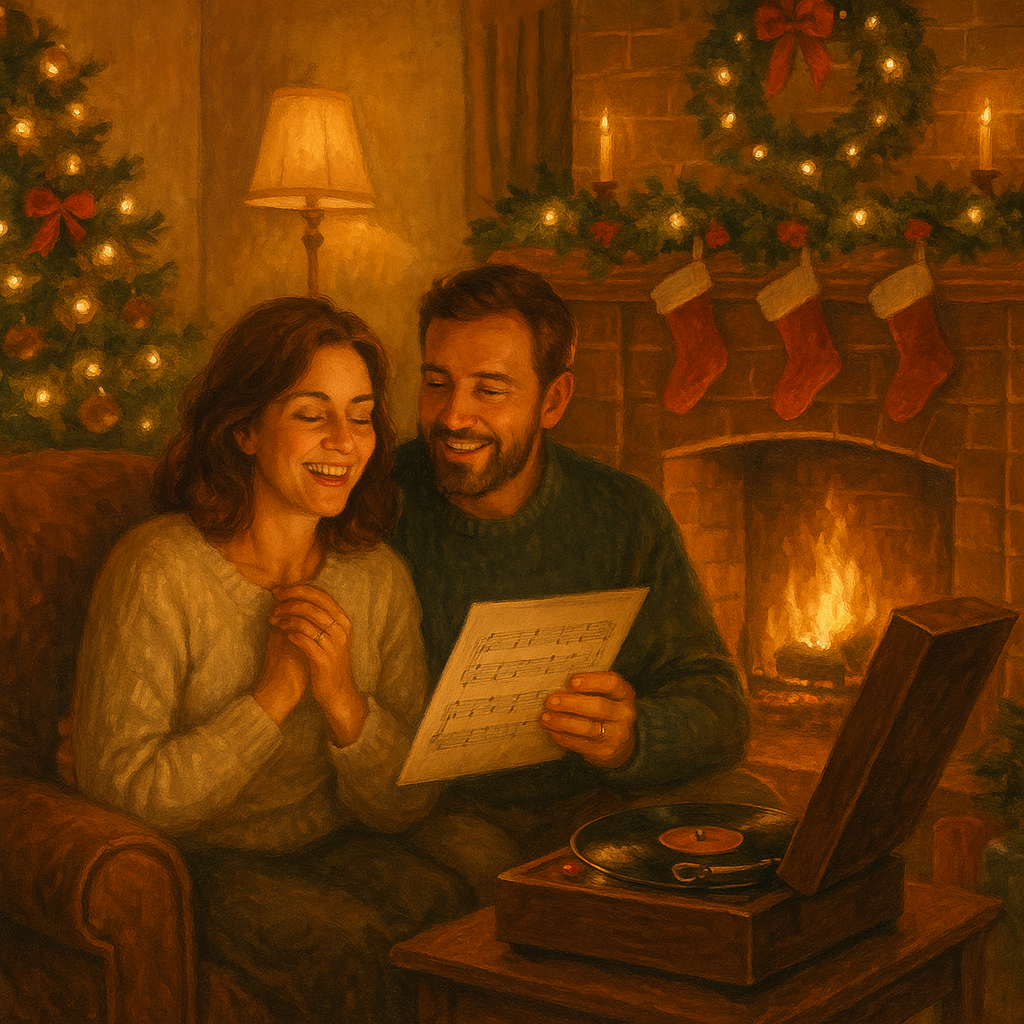
Most years, you end up buying your parents something reasonable. A nice bottle. A scarf. A kitchen gadget they will use twice. They smile, they mean it, and then it goes in a drawer next to the other reasonable things. The gift was fine. It just was not the thing you actually wanted to say.
This guide is for the people who keep meaning to say the bigger thing and never quite find the moment. A personalized Christmas song is one way to do it without making a speech. Done well, it sounds like your family. Done badly, it sounds like a greeting card set to a backing track. The difference is in the details.
Short answer
If you want a Christmas gift for your parents that actually lands, write them a song that names the home they built — the specific kitchen, the specific car trips, the specific phrases — and thanks them for the atmosphere, not just the favors. Use Songilingy's guided flow to set the occasion, the recipients, genre, vocals, language, and the memories you want in the lyrics, hear two complete versions free, and only then decide if one is right to give. Start here: start your parents' Christmas song, or see the Christmas gift for parents page for examples and a plan for a gift from all the siblings.
Why parents are genuinely hard to buy for
It is not that your parents are picky. It is that by this stage of life, most of them have what they need, have stopped asking for things, and have quietly absorbed the idea that birthdays and Christmases are for the kids. When you ask what they want, they say "nothing, honestly." They mean it.
What is missing is rarely an object. Pew Research has noted that parents and their adult children stay deeply connected well into adulthood, with care and support flowing in both directions long after the kids move out. That ongoing closeness is exactly the thing that resists being wrapped. You cannot put twenty-five years of school runs and quiet worry inside a box from a department store.
A song can hold some of that because it does what objects cannot: it names things out loud.
Why a song works when you name the family culture
Researchers at the Greater Good Science Center have written about gratitude as a relational act. It only really lands when the other person feels seen — when you name what they did and what it says about who they are, not just how you benefited. A vague "thanks for everything" bounces off. "Thanks for driving two hours every other Sunday in that old blue Astra so I would not have to take the train alone" does not.
A Christmas song aimed at your parents is your chance to do the named version. Not a list of favors. Not a debt ledger. The atmosphere they built. Think about:
- the noisy kitchen with the radio always on the wrong station
- the Sunday phone calls that go on too long and then suddenly end
- the packed car at the start of every holiday, the argument about the route, the same rest stop
- the old sofa with the dip in it that nobody is allowed to throw out
- the school runs in the dark in February
- the table rules: no phones, finish what is on your plate, ask before you leave
- the sayings that only your family uses, the ones you accidentally say to colleagues
- the holiday arguments that everybody now tells as a story
- the quiet support — the rides, the lent money never mentioned, the second opinion on the apartment you almost rented
- the way they made home feel either safe, or lively, or both, depending on the day
This is the material. This is what makes a song for your parents sound like your parents and not anyone else's.
One song for both, or one each?
This is the first real decision and it matters more than the genre.
One song for both parents works when your parents read as a unit in your head. You picture them in the same room, finishing each other's sentences, splitting the school runs, doing Christmas together as a team. The song can move between them — a verse that nods to your mom's part of the picture, a verse for your dad's — and land on a chorus about the home they made together.
Separate songs work when the relationships are genuinely different, or when one parent has been the main keeper of a tradition that deserves its own track. They also work if your parents are no longer together and a joint song would feel false. A dedicated song for mom can sit with the specific way she shows love. A dedicated song for dad can do the same for him, in his own register. Nobody has to share a verse with anyone.
A combined song with a solo bridge is the third option. Most of the track is about both of them, but there is a moment — eight bars, a quiet bridge — that talks to one of them directly. This is useful when one parent has been through something the other has not, or when one of them is harder to reach with words.
If you are stuck, the song for parents page has examples of how each shape sounds.
A detail map for the lyrics
When Songilingy asks you for memories, details, and stories, this is the part where it is easy to freeze and write "they are the best parents in the world." That sentence is true and useless. Here is a map you can borrow from instead. Pick five or six items across the categories, not twenty.
Home details. The street, the front door color, the smell of the hallway in winter, the specific chair your dad sits in, the radio station, the dog.
Christmas rituals. Who puts the tree up. Who hides the chocolates. The film that goes on every year whether anyone watches it or not. The walk after lunch. The argument about the heating. Midnight mass or no church at all. The year someone forgot the gravy.
Private sayings. The phrases only your family uses. The nicknames. The thing your mom says when she is pretending not to be worried. The thing your dad says before a long drive.
Sacrifices you understand better now. The job they did not take. The house they did not move to. The years they ate the burnt toast so you got the good slice. You do not have to spell these out as sacrifices — the song works better if you just name the thing and let it sit.
Music references. What was actually playing in the house. Fleetwood Mac on a Saturday morning. Whitney while cleaning. Country on long drives. A specific carol your mom hums while wrapping. This is how the song can sound like their world, not just yours.
Food. The Sunday roast that is non-negotiable. The dessert that only appears at Christmas. The recipe that came from a grandmother nobody met. The mug that is technically your dad's.
Travel and movement. The annual drive somewhere. The airport pickups. The way your mom still waves from the doorway until the car turns the corner.
Values. Not as slogans. As actions. "You never let us leave a friend behind at a party." "You always paid people back the same week." "You sat through every match in the rain."
How they showed love. Some parents say it. Some parents fill the fridge. Some parents fix things without being asked. Name the dialect.
Write five or six of these into the description field on Songilingy when you build the song. Specific beats sentimental every time. Research on music-evoked autobiographical memories suggests songs hook into very particular images and moments — a smell, a room, a phrase — far more than into general feelings. Give the song the particulars and it will do the rest of the work.
What to avoid
A few traps worth naming, because they are the difference between a song your parents replay and one they politely thank you for once.
- A debt list. "Thanks for paying for university, thanks for the car, thanks for the deposit." This reads as accounting. Even when it is true, it flattens the relationship into transactions.
- Guilt. "I know I do not call enough." Christmas morning is not the moment.
- Unresolved pain. If there is a real fracture in the family, a song will not fix it and may make it louder. A gentler track that does not pretend everything is fine is more honest than a triumphant one that does.
- Sibling scorekeeping. If you have siblings, either make the song from all of you, or make it clearly from you alone. Do not write a solo song that performs as a group one.
- Money details. Numbers age badly and feel small.
- Punchline parents. Gentle humor is good. A whole verse where your dad is the joke is not.
- Lines that do not sound like your family. If your mom has never used the word "journey" in her life, do not put it in the chorus.
Genre and mood, matched to the parents you actually have
The genre should sound like a record your parents would not skip. Some pairings that tend to work:
- Warm acoustic, fingerpicked guitar. For parents who like things understated. The lyrics carry the weight; the music stays out of the way.
- Classic soul. For parents who grew up on Stevie, Aretha, Marvin. A song that sounds like Sunday morning in their kitchen.
- Cozy piano ballad. For the parent who cries at commercials. Use sparingly; it is powerful and easy to overdo.
- Festive folk. Sleigh bells kept light, acoustic guitar, the kind of track that fits a fire and a glass of something.
- Old-school pop. For parents who like a chorus they can sing along with on the second listen.
- Country storytelling. If your family runs on stories, country gives you room for verses that are basically little scenes.
- Bilingual lines. If your parents speak another language at home, a verse or even a chorus line in that language often hits harder than the English ones. Songilingy lets you set the language in the guided flow.
- Gentle humor in the chorus. A single funny line in an otherwise sincere song — the burnt gravy, the wrong rest stop — can save the whole track from feeling staged.
You can also blend genres in the flow, which is useful when your parents have different tastes. A folk verse into a soul chorus is not a strange request; it is how you respect both of them.
If you want to hear how different moods land, the song samples page has a range, and the gift song ideas page sorts things by occasion.
How Songilingy actually puts it together
The guided flow is meant to keep you out of the trap of staring at a blank page. You move through a few short steps:
- Occasion. Christmas, in this case, which shapes the warmth and the seasonal imagery without forcing snow into a family that has never seen any.
- Recipient and name. Mom, Dad, both, by name or by the name you actually call them.
- Genre or blend. One genre or a combination, as above.
- Vocals. Male, female, or left open. Match the voice to the song in your head.
- Language. English, another language, or a mix if your family lives in more than one.
- Memories, details, stories. This is the field where the detail map goes. Five or six specifics, not a paragraph of feelings.
Songilingy drafts the lyrics from your details and you can edit any line before the music is made. Then you hear two complete versions free before you decide anything. Listen the whole way through, not just the first thirty seconds. If neither is right, use Make changes to adjust a line or the music and hear a new pair. When one is right, you unlock it for $29.99 and it lands in your dashboard, ready to download, with a download link in the delivery email. For a fuller walkthrough of how this works across different occasions, the personalized song gift guide covers it.
Delivering it without making it weird
The gift is half the song and half how you hand it over. A few options that work:
- After dinner on Christmas Day, plates cleared. Phones down, speaker on, let it play. Do not narrate over it. Do not watch their faces the whole time; let them have the moment.
- A private reveal page on Christmas Eve. For parents who would rather not cry in front of the whole family.
- Printed lyric sheet inside a card. Especially useful if one parent is hard of hearing or prefers to read the words while it plays.
- A QR card. Small, neat, slips into a stocking. They scan it and the song plays.
- A sibling group send. If you and your siblings went in on it together, send it in the family thread in the morning with a short note about who wrote what details.
- Email for replay. Parents lose links. Email it to them so it is there in February when they want to hear it again.
- One reveal link for family abroad. If your parents will be alone or away from some of the family, the reveal page lets relatives in another country open the same song, photos and message at the same time.
If you want to lean further into the thank-you framing rather than the Christmas framing, the thank-you song page has more on that angle.
Three short examples
Made up, not templates. Just to show how different families end up with different songs.
One song, both parents, warm acoustic. A daughter writes about the green kitchen in the house they sold in 2019, the radio always on Magic, her mom's habit of singing along one beat behind, her dad's silent way of leaving a cup of tea on her desk during exams. The chorus thanks them for the noise and the quiet, in that order.
Separate song for dad, country storytelling. A son writes about every long drive he and his dad took to away matches, the same gas station, the cheese sandwiches, the radio commentary, the year they got lost and ended up at the wrong ground. The bridge is just: "You never told me you were tired."
Bilingual song for mom, classic soul. A daughter writes about her mom's Saturday cleaning playlist, the Portuguese phrases she still says when she is annoyed, the cake that only appears at Christmas, the way she still packs a bag of food whenever anyone leaves the house. The chorus is half English, half Portuguese, and lands on the word for home.
None of these would work for anyone else's parents. That is the point.
A taste check before you send it
Before you hand it over, run the song past these questions:
- Does it name at least three things only your family would recognize?
- Would your parents recognize themselves, or could this be about anyone's mom and dad?
- Is there one line that is just true, with no decoration?
- Have you avoided guilt, debt, and punchlines at one parent's expense?
- If you have siblings, are they either in the song or clearly not in it on purpose?
- Does it sound like a record they would actually play, not one they would politely endure?
- Is there a moment of lightness somewhere, so the whole thing is not heavy?
If you can answer yes to most of these, it is ready.
FAQ
What if my parents are not sentimental and would be embarrassed by a song? Lean into humor and specifics rather than sweeping declarations. A warm, slightly funny song about the year the turkey caught fire will land better with non-sentimental parents than a piano ballad about love. The detail does the emotional work without forcing them to feel watched.
Can I write one song from me and my siblings together? Yes. Each sibling contributes two or three details — different memories, different inside jokes — and you put them all into the description. The song ends up sounding like the family as a whole, not one person's version of it.
My parents are divorced. Should I still do one song for both? Usually no. Two songs, one each, almost always feels more honest in that situation. You are not pretending anything; you are giving each of them their own thank-you.
What if one of my parents has passed away? A song that includes a parent who is no longer here is possible, but it changes the shape. It becomes part Christmas gift, part remembrance. Be honest with yourself about what the surviving parent needs to hear this year; sometimes a song that is mostly about them, with a single careful line about the other, is kinder than a split tribute.
How long will the song be? You can't set an exact length: it follows the lyrics. Songs written for you usually run about two and a half to six minutes, and the lyrics review shows roughly how long yours will be. To make it shorter, cut a verse or a repeated chorus before the music is made.
Can I hear it before I pay? Yes. You hear two complete versions free before you decide anything (you need a free account, but no card). If neither is right, use Make changes to adjust it and hear a new pair.
What language should I choose? The one your parents actually use at home, or a mix if your household is bilingual. A chorus line in a parent's first language often hits harder than anything else in the song.
Is this only for Christmas Day? No. You can give it on Christmas Eve in private, the day after Christmas when the house has quieted down, or on the drive home. The song does not have a sell-by date.
Sources and further reading
- Pew Research Center on parents and young adult children
- Greater Good Science Center on gratitude and relationships
- Greater Good Science Center on saying thank you well
- Music-evoked autobiographical memories in everyday life
When you are ready, you can start your parents' Christmas song and use the guided flow to put the detail map to work. Listen to it the whole way through before you decide. If it sounds like them, it is the right one.