
I was thinking about you
The simplest version. A song that lands in their day to remind them they are on your mind, even when you are not together.
Mention where you were when you thought of them, or what triggered it.
For the days that aren't on the calendar
There is no birthday, no anniversary, no big announcement. Just you, thinking about someone, wanting them to know it. That is reason enough.
A just-because song turns that quiet thought into something they can press play on. Built from the small things only you would notice, sung in a voice that fits the feeling.
Most gifts arrive when they are expected. A card on a birthday. Flowers on an anniversary. They are lovely, but they are also scheduled.
A song that shows up on a regular Wednesday means something different. It says you were thinking about them when nothing on the calendar made you do it. That is the part people remember.
You do not need a big reason. You need a real one. Here are the feelings people most often want to put into a song when there is no occasion attached.
The simplest version. A song that lands in their day to remind them they are on your mind, even when you are not together.
Mention where you were when you thought of them, or what triggered it.
The way they hum in the kitchen, the face they make when they read, the order they always get. These tiny observations carry a lot of love.
List three habits or quirks only someone who pays attention would catch.
Not a fix, just a song that sits beside them. Quiet, steady, and aware that things have been heavy.
Name what they have been carrying without trying to solve it.
For long-distance partners, friends who moved, family in another time zone. A song that closes the gap for a few minutes.
Reference the time difference, the last visit, or the next one.
Not the highlights. The grocery runs, the slow Sundays, the inside jokes nobody else would laugh at. The actual texture of being with them.
Pick one ordinary moment that says everything.
No award, no announcement. Just someone showing up for their own life, and you noticing. A song can say that without making it a speech.
Mention what they are working on or holding together right now.
A just-because song lives or dies on specifics. Generic affection sounds like a greeting card. Real details sound like you.
01
The one their coworkers would never guess. That one word can do more than a whole verse of compliments.
02
The diner, the bench, the kitchen, the highway. A location grounds the song in your actual life together.
03
If they laugh at the line on first listen, you did it right. Bring at least one joke that would not make sense to a stranger.
04
What they are dealing with this month. The new job, the long commute, the thing they keep saying they want to start.
05
Or hello, or see you later. The small repeated phrase between you two. Tiny rituals carry enormous weight in a song.
You are not staring at a blank page. We ask, you answer, the song takes shape.
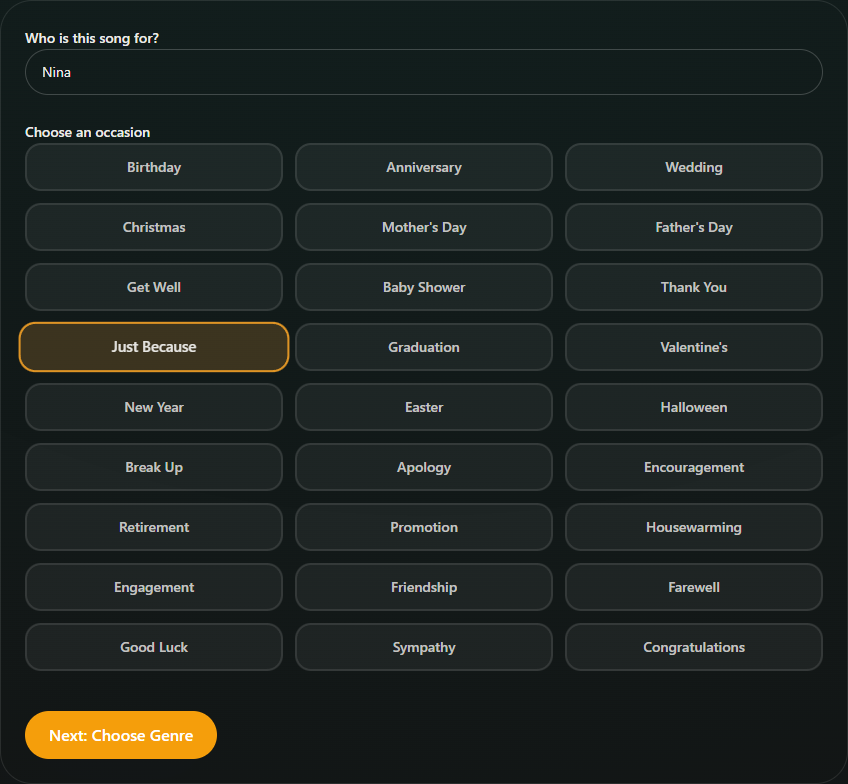
Step 1
Who the song is for, what you want to say, and the memories or details that make them them. The more specific you get, the better it lands.
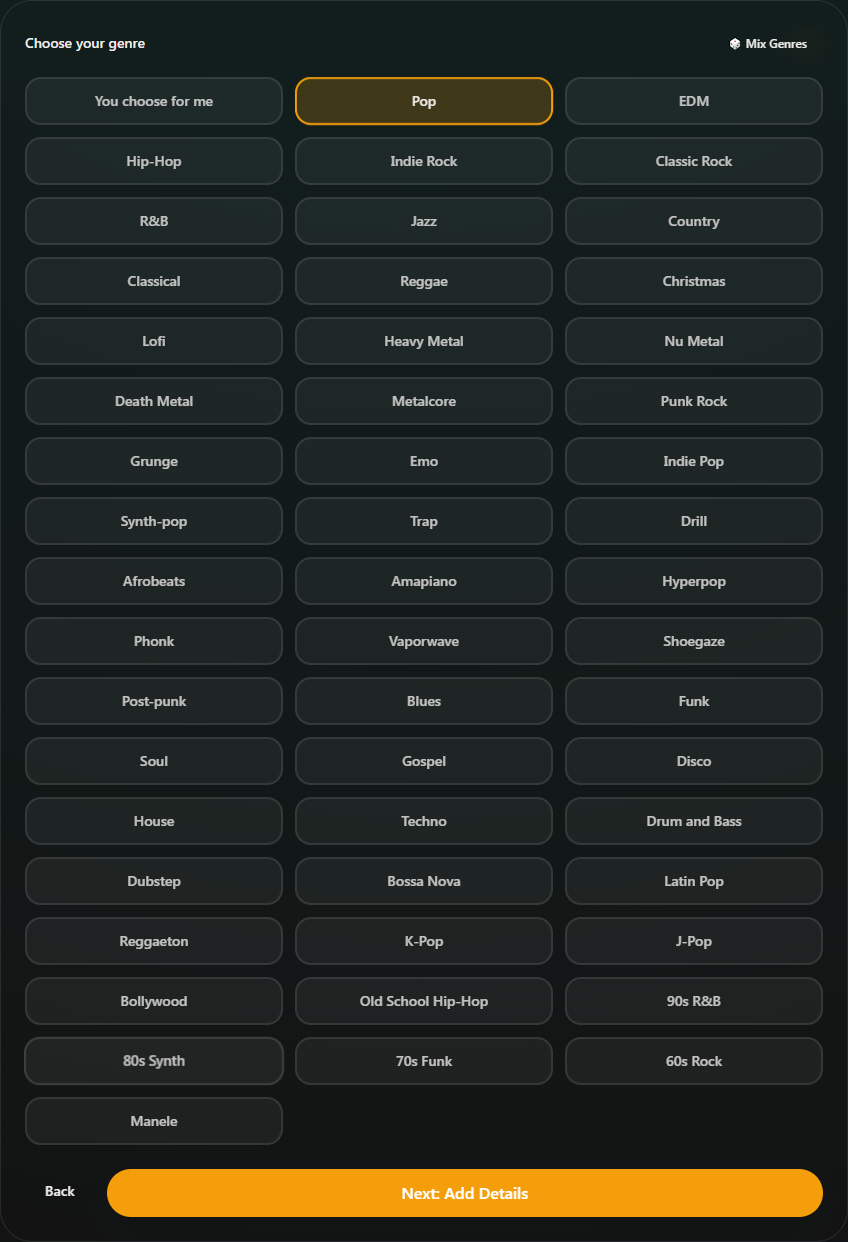
Step 2
Pick a genre or blend two, choose the vocal style and the language. Acoustic and tender, upbeat and warm, indie folk meets soul, your call.
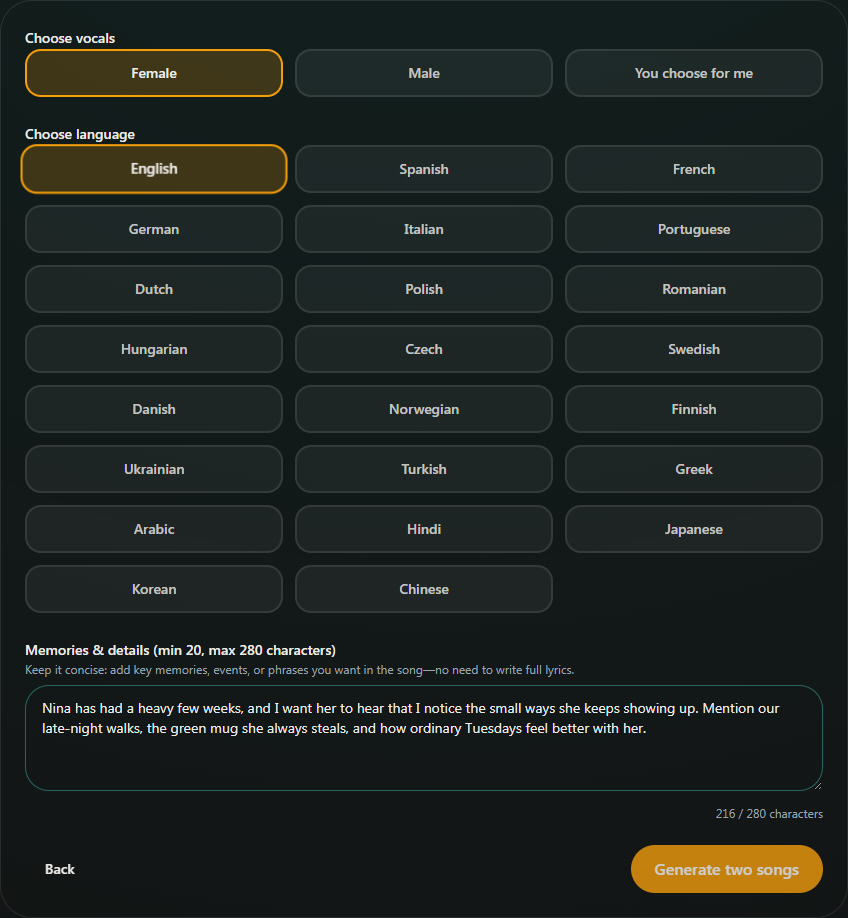
Step 3
The guided flow gives you a free full song preview to listen to before paying anything. When one feels right, unlock the full custom song with vocals for $29.99.
There is no wrong time, but some moments hit harder than others.
Wednesday afternoon is unloved territory. A song landing then is unexpected in the best way.
Not the next morning. That same night, while it still matters. A song can sit with them in a way words sometimes cannot.
A trip, a deployment, a long stretch between visits. Something they can replay when the missing gets loud.
No agenda, no pressure. Just a song that shows up while they are making coffee and changes the temperature of the day.
Just-because songs do not have a single mood. Pick the one that matches how you actually feel when you think of them.
Sound 1
Fingerpicked guitar, a voice that sounds like it is sitting next to them. Best for tender, quiet messages.
Acoustic folk, singer-songwriter
Sound 2
Something that makes them smile on the first chorus. Good for inside jokes and happy reminders.
Indie pop, soft rock
Sound 3
When the feeling is deep but you do not want it to feel heavy. Carries weight without sinking.
Soul, R&B
Sound 4
Plain language, real stories. For people who would rather hear the truth than a metaphor.
Country, Americana
Sound 5
Like a voice note set to music. Casual, close, the kind of thing they listen to twice without telling you.
Lo-fi, bedroom pop
The same feeling can produce two very different songs depending on how you describe it. Specifics are the whole game.
She is funny
She does a voice for the cat and the cat hates it
Names a recurring scene with a punchline. The song now has a character, not a compliment.
We have been together a long time
Seven years, three apartments, one ugly green couch we still have
Timeline plus a stubborn object equals a real history.
He works hard
He leaves before sunrise and still texts me a coffee order at 6:14
Shows effort and tenderness without using either word.
She is my best friend
She is the first call after good news and the only call after bad news
Defines the friendship by role, not by label.
I miss them
Her side of the bed is closer to the window and I still walk around it
Physical detail that turns missing into a habit.
We laugh a lot
We have a running bit about the neighbor's wind chimes that has lasted four years
Ongoing joke with a timeline. That is a song lyric already.
Anyone you want to surprise on a day that does not require it. A few of the people we see most.
Wife, husband, girlfriend, boyfriend. The person who has heard your everyday voice for years and would not expect a song on a regular Tuesday.
Different city, different country, different time zone. A song closes the gap in a way a text cannot.
Friendship songs are rare and that is exactly what makes them land. Especially the unexpected kind.
Parents do not usually get songs unless it is a milestone. Sending one on a normal day says something different.
Brother or sister. People who know the original version of you. A song between siblings is a strange and lovely thing.
Not a fix, not a pep talk. Just a song that sits with them while they get through it.
A few quick sketches of how people use a just-because song. Not scripts, just situations.
She is in back-to-back meetings. He sends a two-minute song instead of a heart emoji. She listens with headphones at her desk and the rest of the day softens.
They have been apart for six weeks. He sends her a soft acoustic song that mentions her morning routine and the cafe they always go to. She plays it on the walk to work.
Her best friend has been quiet all week. She sends a warm, slow song that names what her friend is carrying without trying to solve it. The reply is a voice note crying.
No holiday, no birthday. A daughter sends her mom a country-leaning song about the kitchen, the porch, and the way she always answers the phone. Her mom plays it for the whole family.
Short, honest answers.
A personalized song you send for no formal reason. No birthday, no anniversary, no holiday. The whole point is that you sent it on a regular day, which is what makes it land.
It might be the best time for one. A song with a reason attached can feel expected. A song on a Tuesday does not. The lack of occasion is the gift.
Yes. The guided flow gives you a free full song preview before any payment. You only unlock the full version with vocals when it feels right.
Nicknames, inside jokes, shared places, small habits, what they are dealing with this month. Avoid generic compliments. Specific beats sweet every time.
Yes, and that is mostly about the details you bring. Real specifics keep romance grounded. We also offer sounds like lo-fi, indie, and acoustic that lean honest rather than dramatic.
Absolutely. Friendship and family songs on ordinary days are some of the most memorable ones people send. The format works for anyone you genuinely know.
You get a free full song preview before payment. The full custom song with vocals unlocks for $29.99 when it feels right.
Custom “Just Because” Song songs
You do not need a reason. You already have one. Start with their name, add the details that make them them, and listen back to a version of how you feel about them, set to music.
Use these pages if the song is romantic, long-distance, supportive, or meant for someone specific.
More angles for a song that says something personal without needing a formal date.
Useful when the just-because message is really about distance or absence.
A softer path if the person needs support more than celebration.
Shape the message around romance, daily details, and private affection.
Use this if the surprise is romantic, playful, or long-distance.
A good match when the song is about loyalty, inside jokes, and showing up.
Listen before choosing whether the song should feel intimate, bright, soulful, or relaxed.
Open the guided flow and create a free full song preview for the person on your mind.